



Choosing a Chemical Distribution Partner: A Guide to Technical Sourcing
September 3, 2026
What if the most critical component in your supply chain isn’t the chemical itself, but the technical expertise of the person who shipped it? If you’ve ever dealt with a production delay because a batch of ACS grade solvent didn’t meet the certificate of analysis, you know that a low price is no substitute for precision. Choosing the right chemical distribution partner is about more than just moving pallets. It’s about securing a technical ally that understands the high-stakes nature of your laboratory or manufacturing environment.
You likely agree that inconsistent quality and a lack of direct support are risks your operation can’t afford. This guide provides a framework for evaluating potential partners based on their technical grade expertise, supply chain resilience, and custom manufacturing capabilities. You’ll learn how to identify a distributor that doesn’t just fill orders. Instead, you’ll find a partner that provides the high-purity chemicals and custom blending options necessary to eliminate variables and maintain scientific integrity.
Key Takeaways
- Understand why a strategic chemical distribution partner functions as a technical extension of your facility rather than a mere commodity vendor.
- Learn to navigate rigorous purity standards, including ACS, USP, and SEMI grades, to ensure consistency and precision in your applications.
- Discover the advantages of custom blending and specialized sourcing for reducing in-house handling risks and eliminating production delays.
- Verify supply chain security by prioritizing partners who provide transparent access to Safety Data Sheets (SDS) and certificates of analysis.
- Utilize a technical procurement checklist to audit potential partners on their manufacturing capabilities and expert support levels.
Defining the Strategic Chemical Distribution Partner
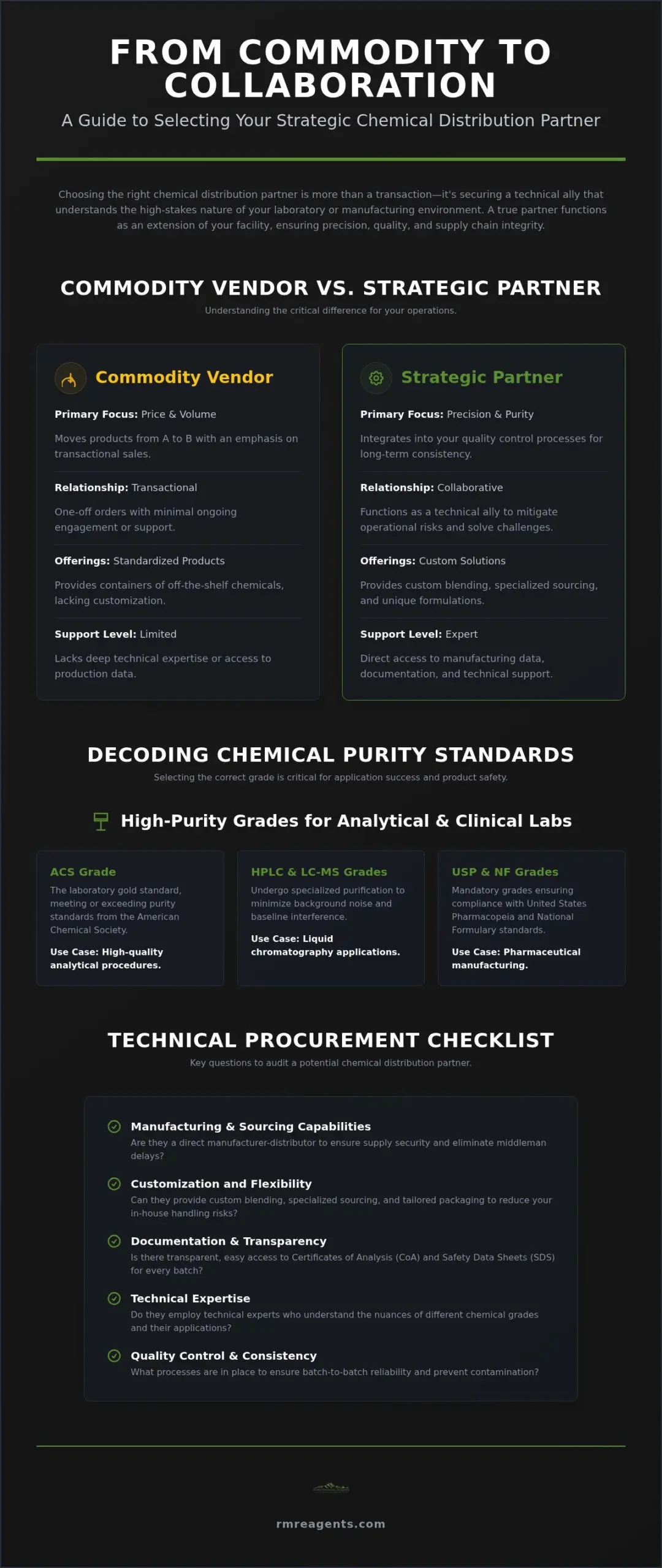
A strategic chemical distribution partner functions as a technical ally in supply chain integrity, bridging the gap between raw material production and the precise requirements of your facility. While a commodity vendor simply moves product from point A to point B, a true partner integrates into your quality control processes. This relationship is built on a shared commitment to precision, where the distributor understands that a single outlier in a batch can derail months of research or production. Instead of focusing on one-off transactional sales, a partner prioritizes long-term consistency and the mitigation of operational risks. They act as a technical extension of your laboratory or production line, ensuring that the materials you receive meet every specification required for your specific application.
Vendor vs. Partner: Why Technical Alignment Matters
If your procurement process focuses solely on the lowest price per liter, you may be overlooking the hidden costs of technical misalignment. Vendors provide containers; partners provide comprehensive custom manufacturing services that address specific formulation challenges. Technical alignment ensures that the chemical grades provided match the sensitivity of your analytical instruments. For instance, if you are performing high-pressure liquid chromatography, using a solvent that lacks the necessary purity can lead to baseline noise or column damage. A partner offers transparency in sourcing and manufacturing that generic distributors often lack, allowing you to trace the journey of your reagents from synthesis to delivery. This collaborative spirit transforms the supply chain from a series of hurdles into a streamlined path toward scientific success.
The Role of Manufacturer-Distributors in Supply Security
The most resilient supply chains often rely on the manufacturer-distributor model. This hybrid approach eliminates middleman delays and significantly reduces the risk of cross-contamination that can occur in non-specialized third-party warehouses. When your chemical distribution partner is also the manufacturer, you gain direct access to production data and batch-to-batch reliability that a broker cannot offer. This control is vital for high-stakes applications, such as the production of semiconductor-grade acids or complex custom liquid blending. Proper chemical storage and handling protocols are strictly maintained within these specialized facilities, ensuring that the integrity of the material is protected at every stage. By streamlining the manufacturer-to-user relationship, you remove unnecessary variables and secure a more predictable production schedule for your operation.
Navigating Chemical Grades and Purity Standards
The choice of chemical grade dictates the success of your application and the safety of your end product. When you select a chemical distribution partner, you aren’t just buying a substance; you’re buying the assurance that the material meets specific technical monographs. Expert partners must possess a deep understanding of standards set by organizations like the American Chemical Society (ACS) and the United States Pharmacopeia (USP). Misidentifying a requirement or settling for a lower grade to save costs often leads to failures, such as instrument downtime in high-sensitivity labs or failed quality control in pharmaceutical research. ACS Grade is the laboratory gold standard for analytical work.
High-Purity Grades for Analytical and Clinical Labs
Precision in the lab requires reagents that eliminate variables. If your work involves complex instrumentation, the purity of your solvents is non-negotiable. You can learn more about our commitment to quality and how we maintain these rigorous standards across our product lines.
- ACS Grade: This grade meets or exceeds the stringent purity standards established by the American Chemical Society. It’s the benchmark for high-quality laboratory chemicals used in analytical procedures.
- HPLC and LC-MS Grades: These solvents undergo specialized purification to minimize background noise and baseline interference. They are essential for liquid chromatography where even trace contaminants can ruin a sample.
- USP and NF Grades: These are mandatory in pharmaceutical manufacturing and clinical settings. They ensure compliance with the United States Pharmacopeia and National Formulary standards for identity, strength, and purity.
Industrial and Specialized Manufacturing Grades
Manufacturing environments have diverse needs, ranging from semiconductor fabrication to food production. Your chemical distribution partner should guide you through these specialized classifications to ensure regulatory compliance and process efficiency.
- SEMI Grade: Specifically engineered for the electronics industry, these chemicals meet the extreme purity requirements of semiconductor manufacturing to prevent wafer contamination.
- FCC Grade: This classification meets Food Chemical Codex standards. It’s the requirement for chemicals used in food, beverage, and nutritional supplement production.
- Technical Grade: While not suitable for food or medicine, technical grade is appropriate for general industrial use where high purity isn’t a functional requirement.
- Absolv™ Grade: These ultra-high-purity solvents are designed for critical synthetic applications where trace impurities must be strictly controlled.
Selecting the correct grade prevents rework and protects your equipment. If you’re unsure which standard fits your specific process, reach out to our technical team for expert guidance on grade selection and technical sourcing.
Custom Blending and Specialized Sourcing Solutions
A sophisticated chemical distribution partner provides value far beyond a standard catalog of stock items. For many industrial applications, off the shelf products don’t meet the precise concentration or mixture requirements of a complex process. By utilizing custom chemical formulations, you ensure that your materials are tailored to your specific technical needs from the start. Outsourcing this blending process significantly reduces your in house handling of hazardous materials and improves batch consistency. It allows your team to focus on core research or production while an expert facility handles the high accuracy preparation of your reagents. This strategic shift eliminates the common variables that lead to production delays and ensures a more streamlined path to your desired outcomes.
Specialized sourcing is another critical component of a technical partnership. Finding hard to find reagents or creating proprietary buffers often requires deep industry connections and manufacturing flexibility that a simple broker cannot provide. If a project demands a niche material with a specific impurity profile, your partner should have the capability to source or synthesize that material to your exact standards. This proactive approach to sourcing protects your operational momentum and prevents the supply chain bottlenecks that often derail high stakes scientific work.
The Value of Custom Liquid Blending Services
Outsourcing your liquid blending ensures that every titrant and standard is prepared to exact specifications without the risk of manual error. This service reduces the need for on site laboratory preparation, which saves significant time and labor costs for your facility. RMR Reagents provides custom manufacturing for scientific grade solutions, delivering precise formulations that integrate directly into your existing workflows. By relying on professional grade blending, you gain a level of repeatability that is difficult to achieve in a typical busy laboratory environment.
Forensic and High-Precision Reagents
Forensic chemistry requires a specialized partner that understands the necessity of consistency in evidence detection. Partners like Pioneer Forensics focus on refined formulations of critical reagents like luminol and indanedione. These chemicals must perform reliably under real world conditions to move forensic results from expert opinion to data driven conclusions. Whether you are developing latent fingerprints or detecting trace amounts of blood, the purity and stability of your reagents are non negotiable. Maintaining total traceability for these biological stains and forensic chemicals ensures that every result is backed by scientific rigor and verifiable data.
Ensuring Supply Chain Security and Compliance
Compliance with ANSI/ASHRAE and NSF standards for laboratory equipment is a hallmark of a quality partner. If your facility relies on high-precision measurements, traceability to NIST standards ensures that your buffers and titrants are reliable for calibration. This level of accuracy is essential for meeting the stringent requirements of modern scientific work. By using NIST-traceable materials, you eliminate the guesswork from your results and ensure that your analytical instruments are performing within their intended specifications.
Safety is a shared responsibility between the manufacturer and the user. You should always consult the applicable SDS downloads for specific safety and storage protocols before handling any new reagent. A sophisticated chemical distribution partner distinguishes between general educational information and the specific jurisdictional requirements that vary by application. For instance, recent updates to the Toxic Substances Control Act (TSCA) and evolving state-level regulations on chemicals like PFAS require a partner who stays current with legal mandates. Certifications like ISO 9001:2026, which was published on September 16, 2026, and ISO/IEC 17025:2005 are key indicators of a manufacturer’s commitment to quality. These represent a documented system of risk management and organizational resilience that protects your operation from regulatory drift.
Risk Mitigation in Chemical Procurement
Strategic warehousing and national coverage are the best defenses against supply chain volatility. By working with a partner that operates multiple distribution points, you reduce the risk of a single point of failure. Eliminating variables in chemical purity is your primary defense against common industry failures like contamination or batch inconsistency. You can learn more about our commitment to quality and how we maintain these rigorous standards across our national network. Consistency in your chemical supply translates directly to consistency in your production or research outcomes, allowing you to focus on your core scientific objectives without the distraction of procurement failures.
How to Evaluate a Chemical Partner: A Procurement Checklist
Transitioning from a transactional vendor to a long-term technical ally requires a methodical vetting process. You need to know if a potential chemical distribution partner can actually support the precision of your work or if they’re just a middleman with a warehouse. This checklist helps you audit their capabilities against the specific needs of your laboratory or production line. It’s about ensuring that every bottle and every batch meets your internal quality benchmarks without exception. If a supplier cannot answer technical questions about impurity profiles or batch traceability, they aren’t a partner; they’re a risk.
- Grade Availability: Does the partner offer the specific chemical grades (ACS Grade, SEMI Grade, USP, FCC) required for your application?
- Customization: Can they provide custom blending and specialized sourcing for hard-to-find materials or proprietary formulations?
- Transparency: Is there direct access to technical experts and clear SDS documentation for every product?
- Industry Experience: Do they have a proven track record in your specific sector, such as forensics, electronics, or pharmaceuticals?
Technical Capability and Product Range
A partner’s catalog should reflect the depth of their technical expertise. You should verify the availability of reagent grade acids and bases to ensure they can meet the foundational needs of your analytical work. Beyond chemicals, assess their range for specialized items like heat transfer fluids, purification media, or biological stains. A comprehensive partner also stocks essential lab equipment, such as OHAUS balances and safety gear like nitrile gloves. This one-stop-shop capability reduces procurement friction and ensures that all components of your workflow meet the same rigorous standards of excellence. If they don’t stock the specialized grades you need for semiconductor or forensic work, they likely lack the infrastructure to support your growth.
Communication and Support
Technical sourcing is rarely a straightforward purchase; it often involves complex, custom requirements that demand human expertise. Your partner should be approachable and capable of discussing high-stakes scientific work without getting lost in corporate jargon. Look for a responsive contact-us process for product inquiries where you speak directly to someone who understands chemistry. If your work involves calibration, evaluate their ability to provide NIST traceable buffer solutions. This direct access to technical support ensures that when a challenge arises, you have an ally ready to provide a functional remedy rather than a generic excuse. Reliability is built on these interactions, turning a simple supply chain into a productive collaboration.
Securing Your Technical Future through Strategic Sourcing
Selecting the right chemical distribution partner is a decision that impacts every stage of your scientific or industrial process. By prioritizing technical grade expertise and verified supply chain security, you move beyond simple procurement and into a relationship that protects your operational integrity. Whether you require standard ACS Grade reagents or specialized formulations from our Pioneer Forensics brand for evidence detection, the goal remains the same: the total elimination of variables. Trusting your supply chain to an expert ally ensures that your facility remains focused on results rather than logistics.
As a direct manufacturer of ACS, SEMI, and USP grade chemicals, RMR Reagents provides national distribution with a focus on high-purity standards. We don’t just ship products; we provide the technical support and custom manufacturing capabilities necessary to solve your most complex sourcing challenges. Our hybrid model allows us to maintain strict quality control from synthesis to delivery, providing you with the reassurance that every batch meets the most rigorous industrial monographs.
Your success depends on precision, and we are ready to help you achieve it through unwavering excellence and steadfast support.
Frequently Asked Questions
What is the difference between a chemical vendor and a distribution partner?
A vendor typically focuses on transactional sales of commodity products, while a chemical distribution partner serves as a technical extension of your laboratory. Partners prioritize long term consistency and offer specialized services like custom liquid blending or hard to find material sourcing. This collaborative approach ensures that the chemical grades match the sensitivity of your specific analytical instruments, reducing the risk of failed quality control or production delays.
Why is ACS grade considered the gold standard for laboratory chemicals?
ACS Grade is considered the laboratory gold standard because it meets or exceeds the stringent purity standards set by the American Chemical Society. These chemicals are ideal for general analytical and laboratory use where high precision is non negotiable. Using this grade ensures that your reagents have a known impurity profile, which is critical for achieving repeatable results in pharmaceutical research and high stakes scientific work where variables must be strictly controlled.
Can a chemical distribution partner help with custom formulations?
Yes, a sophisticated partner provides custom blending services to create specific chemical formulations tailored to your unique industrial requirements. This service allows you to outsource the preparation of titrants, standards, or proprietary buffers, which improves batch to batch consistency. It also reduces your in house handling of hazardous materials and saves significant labor costs. Expert partners use refined formulations to ensure that every blend meets your exact technical specifications every time.
What industries require SEMI grade chemicals?
SEMI Grade chemicals are specifically engineered for the electronics design and manufacturing industry. These materials meet or exceed the Semiconductor Equipment and Materials International monographs, ensuring the ultra high purity required to prevent contamination during wafer fabrication. Because even trace impurities can cause catastrophic failures in microchips, semiconductor producers rely on these specialized acids and solvents to maintain the integrity of their complex manufacturing processes.
How do I find the Safety Data Sheet (SDS) for a specific chemical?
You can typically find the necessary documentation through a dedicated SDS downloads portal on your partner’s website. These sheets provide critical information on safety, storage, and handling protocols specific to the chemical you are using. A quality chemical distribution partner ensures that these documents are easily accessible and up to date, helping your facility maintain compliance with workplace safety standards and jurisdictional requirements for hazardous material management.
Are Absolv™ grade solvents better for HPLC applications?
Absolv™ Grade solvents are ultra high purity materials specifically engineered for critical analytical techniques like HPLC, LC/MS, and gas chromatography. They are refined to meet or exceed stringent purity standards, making them superior for applications where trace impurities could interfere with signal detection. Using these high performance solvents helps eliminate baseline noise and protects expensive chromatography columns from damage, ensuring the highest level of accuracy in your analytical results.
What are the benefits of sourcing chemicals from a manufacturer-distributor?
Sourcing from a manufacturer distributor eliminates middleman delays and reduces the risk of cross contamination in the supply chain. This model provides direct access to production data and technical experts who understand the chemistry behind the products. You gain better batch to batch reliability and the flexibility of custom manufacturing options. It streamlines procurement by combining high purity chemical production with national distribution, ensuring a more resilient and transparent relationship for your facility.
How does NIST traceability affect laboratory results?
NIST traceability ensures that your buffers and standards are calibrated against recognized national standards, providing a documented pedigree of accuracy. This eliminates guesswork in your laboratory results and ensures that your analytical instruments are performing within their intended specifications. For industries like forensics or pharmaceutical research, this traceability is essential for moving conclusions from expert opinion to data driven facts. It guarantees that your measurements are consistent and legally defensible.
Disclaimer
The information provided in this article is for general educational and informational purposes only and is not intended to replace product-specific technical documentation, Safety Data Sheets (SDS), professional advice, or applicable regulatory requirements. Chemical properties, applications, handling procedures, and regulatory requirements may vary by product, concentration, use, and jurisdiction. Always review the applicable SDS and product documentation and follow appropriate workplace safety procedures before handling or using any chemical product. Contact Rocky Mountain Reagents for product-specific specifications or technical information.

