


High Precision Lab Equipment: A Practical Guide to Reliable Measurements
September 30, 2026
The instrument with the most impressive specification isn’t automatically the right one for your lab. Choosing high precision lab equipment means matching its documented performance to the measurement, method, and conditions your workflow requires.
A device’s stated precision is only one part of the decision. It doesn’t tell you on its own whether results will be accurate, repeatable, or sufficiently resolved for your application. These terms describe different aspects of measurement performance. Confusing them can lead to equipment that looks suitable on paper but doesn’t fit the work you need it to do.
This guide explains how to distinguish precision, accuracy, resolution, and repeatability, then use those concepts to compare equipment. You’ll learn to assess specifications against your sample, measurement range, operating conditions, and documentation needs, and to prepare practical questions for a supplier. For weighing workflows, OHAUS balances distributed by RMR Reagents provide an example of how to assess equipment in context. The goal is a dependable measurement system, not simply a compelling number on a specification sheet.
Key Takeaways
- Separate precision, accuracy, resolution, and repeatability to interpret equipment claims correctly.
- Evaluate the whole measurement system: instrument, method, operator, sample, environment, and records.
- Compare high precision lab equipment with your intended use, measurement range, readability, repeatability, and documentation needs.
- Define workflow requirements and involve laboratory, purchasing, engineering, and quality stakeholders before selecting equipment.
- RMR Reagents distributes OHAUS balances. Check current specifications in the applicable manufacturer documentation.
What Does High Precision Lab Equipment Mean in Practice?
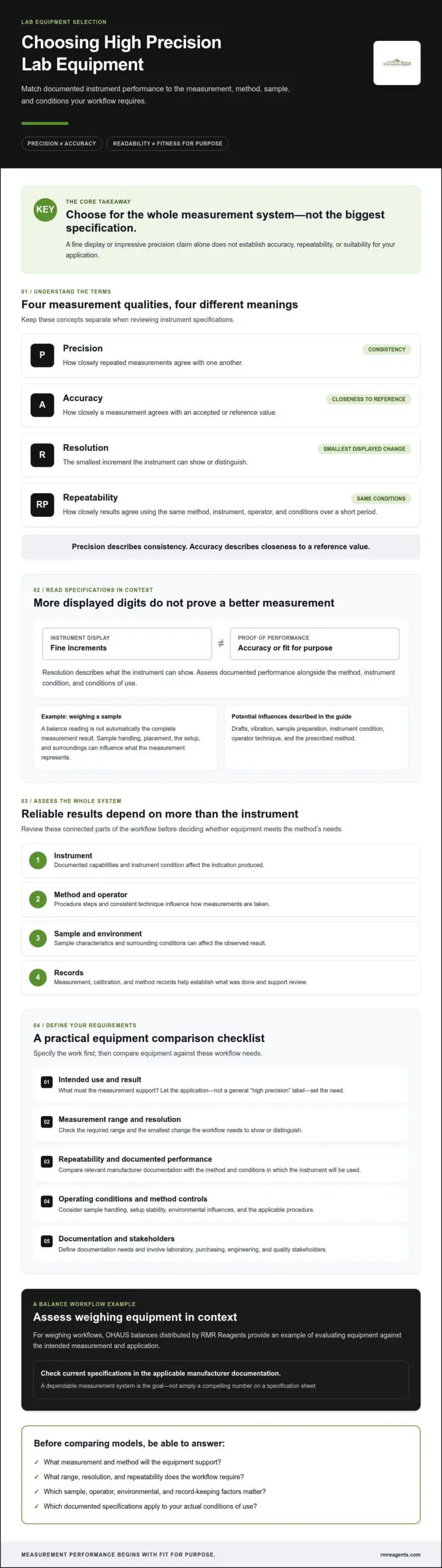
High precision describes equipment designed to produce consistent measurements with fine resolution. But the phrase alone doesn’t establish whether an instrument suits a particular method. Resolution is the smallest change an instrument can display or distinguish; precision concerns the consistency of measurements. A fine display can show more digits without proving that a result is accurate or fit for purpose.
Four related qualities help explain measurement performance:
- Precision: How closely repeated measurements agree with one another.
- Accuracy: How closely a measurement agrees with an accepted or reference value.
- Resolution: The smallest increment the instrument can show or distinguish.
- Repeatability: How closely results agree when the same method, instrument, operator, and conditions are used over a short period.
These terms describe different things, even though they’re often grouped together in equipment discussions. In brief, precision describes consistency, while accuracy describes closeness to a reference value. The concepts of accuracy and precision are useful to review when interpreting measurement claims.
Consider weighing a sample for a laboratory procedure. A balance displays a reading, but that reading isn’t automatically the complete measurement result. The sample, container, handling, environment, instrument condition, and prescribed method can all affect what the measurement represents. A display with fine increments cannot, by itself, correct for a draft, an unstable setup, or inconsistent sample handling.
How Do Precision, Accuracy, and Resolution Differ?
Imagine weighing the same prepared sample repeatedly. Similar readings indicate consistency under those conditions, but they don’t establish that the result is accurate. If the balance displays small increments, that describes resolution, not necessarily how close the reading is to a reference value. Assess the documented performance of the instrument alongside the method and conditions of use.
Repeatability matters when routine measurements need to agree under consistent, controlled conditions. If the operator, environment, sample preparation, or procedure changes, results may vary for reasons beyond the instrument. Identify these influences before deciding which equipment characteristics matter most.
Which Laboratory Workflows Depend on Precise Measurement?
How Do Measurement Systems Influence High Precision Lab Equipment?
Reliable results depend on the measurement system, not the instrument alone. The method, operator, sample, surrounding conditions, and records all influence how equipment performs in a real workflow. Assess these factors together before deciding whether high precision lab equipment meets the method’s needs.
For example, a balance reading can be affected by sample preparation and placement, the stability of the setup, and conditions such as drafts or vibration. Other analytical workflows may be sensitive to different factors. Follow the applicable method and manufacturer documentation for setup and sample handling; general guidance cannot replace method-specific requirements.
- Instrument: Its documented capabilities and condition affect the indication it produces.
- Method and operator: Procedure steps and consistent technique influence how measurements are taken.
- Sample and environment: Sample characteristics and surrounding conditions can affect the observed result.
- Records: Measurement, calibration, and method records help establish what was done and support review.
The American Chemical Society’s overview of Accuracy and Precision offers useful context for interpreting measurement results. Measurement uncertainty is another part of the assessment. It expresses the limits of confidence around a reported result, based on relevant sources of variation and the method used to evaluate them. It isn’t simply a mistake, and a low uncertainty claim by itself doesn’t establish that a method or instrument is suitable.
Why Do Method and Environment Matter?
Conditions that affect one workflow may be irrelevant to another. A weighing procedure, for instance, may call for a stable setup and consistent handling, while an analytical method may specify different controls. Follow the procedure’s stated requirements and document applicable conditions rather than assuming a general recommendation is sufficient.
What Do Calibration and Traceability Tell You?
Calibration establishes the relationship between an instrument’s indications and reference values under stated conditions. Traceability describes how a measurement result is connected to a recognized reference through a documented chain of calibrations, with uncertainty considered at each step. They’re related, but not interchangeable, and neither alone guarantees a suitable result. Review applicable calibration records and traceability information against your method’s requirements. For background, consult RMR’s NIST-traceable measurement resources.
Before sourcing a balance or related laboratory supplies, clarify what documentation your workflow requires. You can contact RMR about balance and laboratory supply requirements.
How Should You Compare High Precision Lab Equipment?
Which Specifications Should You Check First?
Define the measurand, or the quantity being measured, and the range your samples are expected to cover. Identify the method’s required resolution, then assess repeatability and any stated measurement uncertainty against the intended use. For an analytical balance, compare its documented capabilities with the sample masses and procedure requirements. Don’t assume finer readability alone makes one model the better fit.
| Comparison point | What to confirm |
|---|---|
| Intended use | Does the instrument support the measurement and method you plan to perform? |
| Measurement range | Does the documented range cover your expected samples and routine use? |
| Readability | Are the displayed increments appropriate for the method’s required resolution? |
| Repeatability | What repeatability information does the manufacturer provide, and under what conditions? |
| Documentation | Are the specifications and records available to support your method and internal review? |
Use the same criteria for every candidate. Comparing one instrument’s readability with another’s repeatability, for example, won’t establish which is more suitable. Manufacturer specifications may be stated under particular conditions, so review the supporting documentation rather than treating figures as universal performance guarantees. Before selecting high precision lab equipment, confirm that the documented capabilities address your method requirements. If you’re narrowing down weighing options, this practical buying guide to precision lab balances for sale explains how to compare capacity, readability, workflow fit, and documentation needs.
What Documentation Should You Request?
Ask for the applicable manual and specification sheet, along with calibration records or other support documentation relevant to your method. Check what each document covers, the conditions it describes, and whether it addresses your intended use. Documentation expectations vary by procedure, organization, and application, so identify your needs with laboratory and quality teams before comparing models.
Build the comparison around evidence your team can verify: intended use, range, readability, repeatability, and supporting documents. Ask the supplier to clarify gaps between that evidence and your requirements before making a decision.
How Can You Specify Equipment for a Laboratory Workflow?
How Do You Turn a Measurement Need Into a Specification?
Capture the procedure, sample type, measurement range, expected frequency of use, and records the method requires. Separate essential requirements from preferences, then flag application-specific needs for the technical stakeholders responsible for the method. This gives suppliers a clear basis for responding and gives your team objective criteria for review.
- 1. Define the task. State what you need to measure, the sample involved, and how the result will be used.
- 2. Document requirements. Record the applicable procedure, measurement range, required performance, operating conditions, and records.
- 3. Review constraints. Consider workflow fit, available space, existing processes, purchasing requirements, and method-specific conditions. Have the appropriate technical team confirm any requirements that need interpretation.
- 4. Compare evidence. Check each candidate’s published specifications and available documentation against the written requirements. Note gaps and request clarification rather than treating missing information as confirmation.
- 5. Confirm fit. Bring laboratory, purchasing, engineering, and quality stakeholders together to agree whether the documented offering suits the intended use and procurement needs.
How Do You Review Supplier Information?
Assess supplier information against your documented workflow, not general marketing language. Ask which specifications and records apply to the offering under consideration, what documentation is available, and whether the stated capabilities address your requirements. Confirm availability and communication expectations through the purchasing process. Equipment availability alone doesn’t establish that installation, testing, ongoing support, or guarantees are included.
Keep a simple comparison record with each requirement, its source, and its status: confirmed, needs clarification, or not met. This makes unresolved questions visible before a purchasing decision and helps teams distinguish essential fit from preferred features. For balances, check current specifications against the applicable manufacturer documentation before deciding.
What High Precision Lab Equipment Can RMR Reagents Supply?
RMR Reagents distributes OHAUS balances and laboratory supplies. That’s the equipment scope to consider when evaluating a sourcing need; it doesn’t mean RMR supplies every type of instrument discussed in this guide.
OHAUS offers high-precision electronic and mechanical balances, scales, and laboratory and analytical instruments. RMR Reagents distributes OHAUS balances. To assess whether a balance suits your workflow, compare its current manufacturer documentation with your method, measurement range, and documentation requirements.
When Is an OHAUS Balance Relevant to Your Workflow?
An OHAUS balance may be relevant when your procedure requires weighing and its documented capabilities align with the task. Start with your sample, expected measurement range, required readability, and method conditions. Then check the specific product’s current specifications in applicable OHAUS manufacturer information. Don’t infer suitability from a general product description or the phrase “high precision” alone.
What Should You Include in an Equipment Inquiry?
Make your inquiry specific enough to support a useful sourcing discussion. Describe the weighing task and workflow, summarize relevant method requirements, and note the documentation your team needs to review. Include questions about unclear specifications or records, and identify any details that still require confirmation with your technical stakeholders. This keeps the discussion focused on RMR’s balance and laboratory supply offerings.
Clear requirements help distinguish a potential equipment match from unanswered questions. RMR can be a sourcing contact for its balance and laboratory supply offerings, but equipment distribution alone shouldn’t be taken to imply on-site testing or other services. Confirm product details and availability through the inquiry process, and review manufacturer documentation before making a selection.
Build Confidence Into Your Next Measurement
Reliable results depend on more than an instrument’s headline specification. Match high precision lab equipment to the method, sample, measurement range, and documentation your workflow requires. Keep precision, accuracy, resolution, and repeatability distinct, and assess equipment evidence against its intended use.
A practical specification gives your team a shared basis for decisions: define the measurement task, document essential requirements, review constraints, compare manufacturer information, and confirm fit with laboratory, purchasing, engineering, and quality stakeholders. This process helps surface unanswered questions before procurement.
For weighing needs, RMR Reagents distributes OHAUS balances. OHAUS offers high-precision electronic and mechanical balances. Check current product specifications against manufacturer documentation and your method before selecting equipment.
Have a weighing or laboratory supply requirement? Contact RMR Reagents to discuss your needs and identify the information to review for a potential equipment match.
Frequently Asked Questions
What is high precision lab equipment?
High precision lab equipment is designed to support consistent measurement with fine resolution, but its suitability depends on the method and intended use. Precision describes how closely repeated measurements agree; accuracy describes how closely a result approaches an accepted or reference value. A “high precision” product label doesn’t establish suitability by itself. Review documented specifications against the procedure, sample, measurement range, and conditions in which the instrument will be used.
What is the difference between accuracy and precision in laboratory equipment?
Accuracy concerns how close a measurement is to an accepted or reference value, while precision concerns consistency among repeated measurements. One doesn’t automatically establish the other. Repeated readings could cluster closely together yet differ from a reference value. Method conditions, calibration information, sample handling, and instrument setup all matter when interpreting results, so assess consistency and closeness to the reference separately.
How do I choose high precision lab equipment for my laboratory?
Start with the measurement task, method, sample, expected range, and records the workflow requires. Use those needs to identify relevant specifications, then compare manufacturer documentation and available supporting records. Involve laboratory, purchasing, engineering, or quality stakeholders as appropriate, especially when method requirements need technical interpretation. The right fit is application-specific. Check current product details with the manufacturer rather than relying on a broad precision label or marketing description alone.
Does higher resolution mean a laboratory instrument is more accurate?
No. Resolution describes the smallest increment an instrument displays or distinguishes; it doesn’t necessarily show how close a measurement is to an accepted value or how consistent repeated readings will be. A finer display alone can’t prove a better measurement result. Assess the complete specification, including relevant accuracy and repeatability information, in context, and compare it with the method’s requirements. Instrument characteristics don’t have a universal relationship that establishes suitability for every workflow.
Why do calibration and traceability matter for laboratory measurements?
Calibration documents the relationship between an instrument’s indications and reference values under stated conditions. Traceability describes a documented connection between a measurement result and a reference through a chain of calibrations. These concepts help teams evaluate measurement reliability, but neither alone guarantees accuracy or compliance. Review applicable records and follow your method and organization’s requirements. Confirm that any claimed documentation meets your application’s needs; don’t assume a supplier provides calibration or traceability services.
Does RMR Reagents sell high precision lab equipment?
RMR Reagents distributes OHAUS balances and laboratory supplies. OHAUS offers high-precision electronic and mechanical balances, scales, and laboratory and analytical instruments. RMR distributes OHAUS balances, not every instrument category discussed in this guide. Check current manufacturer product information against your workflow requirements, and discuss your sourcing questions with RMR before deciding whether an offering fits your application.
Disclaimer
The information provided in this article is for general educational and informational purposes only and is not intended to replace product-specific technical documentation, Safety Data Sheets (SDS), professional advice, or applicable regulatory requirements. Chemical properties, applications, handling procedures, and regulatory requirements may vary by product, concentration, use, and jurisdiction. Always review the applicable SDS and product documentation and follow appropriate workplace safety procedures before handling or using any chemical product. Contact Rocky Mountain Reagents for product-specific specifications or technical information.

