


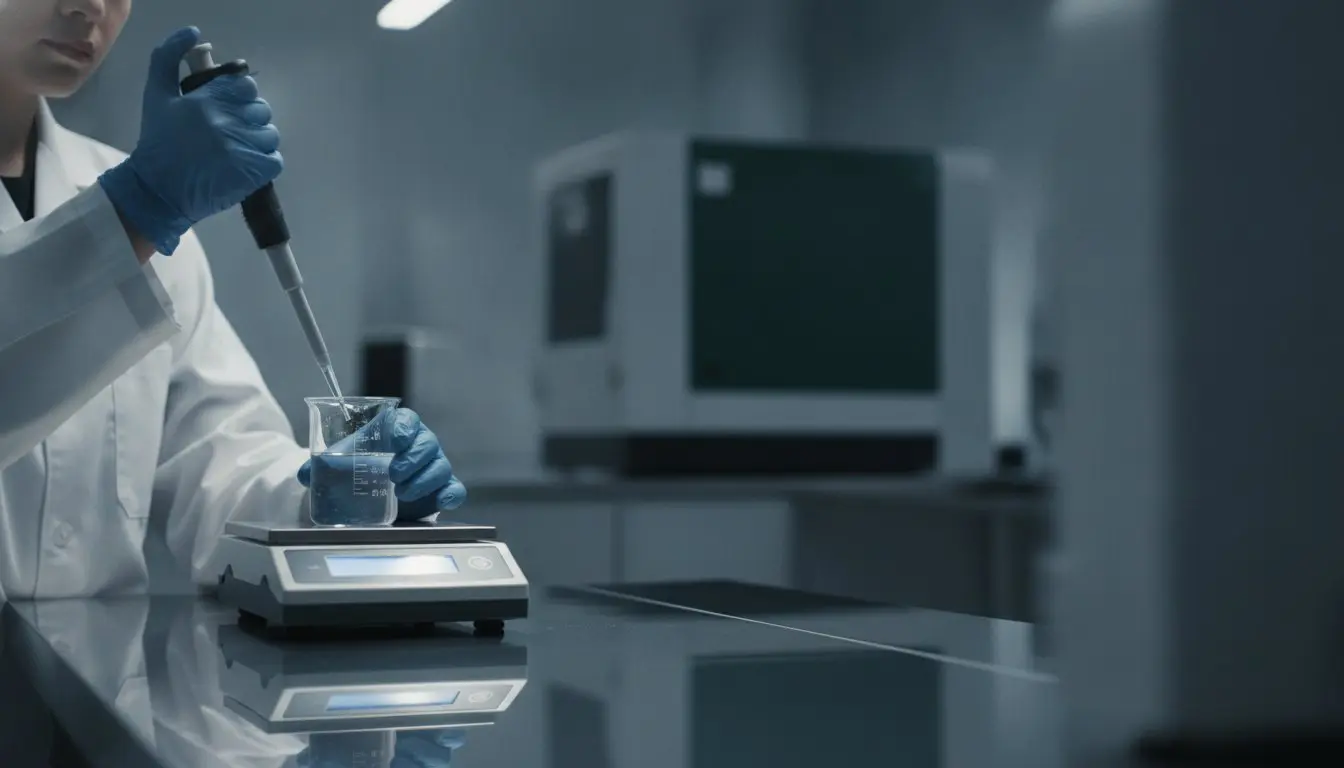
Mastering Laboratory Buffer Preparation: A Manufacturer’s Guide to Precision
September 14, 2026
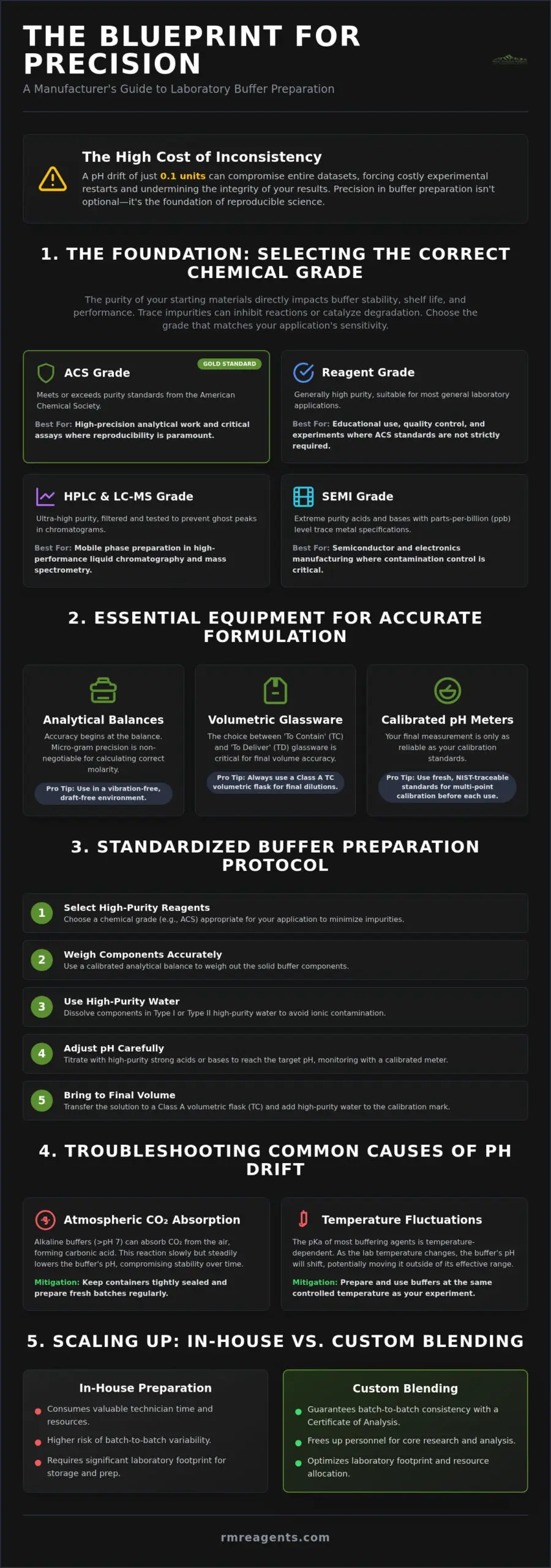
If your buffer’s pH drifts by even 0.1 units during a high-stakes assay, you aren’t just losing a batch; you’re compromising the integrity of your entire dataset. It’s a frustrating reality many lab professionals face when inconsistent results or subtle contamination force a complete experimental restart. Precision in laboratory buffer preparation is the foundation of reproducible science, yet it remains one of the most common points of failure in the modern lab.
We understand that your work depends on stability and chemical purity that doesn’t waver. This guide provides the rigorous manufacturer protocols and chemical grade insights required to eliminate variables and ensure batch-to-batch consistency. You’ll learn how to select the correct chemical grades for your specific application, whether you’re meeting the latest December 2026 USP requirements or referencing the dynamic ACS online standards. We’ll also outline a standardized SOP that addresses weighing accuracy, storage equilibrium, and the critical role of NIST-traceable standards in maintaining experimental control.
Key Takeaways
- Select high-purity chemical grades like ACS or USP to prevent trace impurities from interfering with sensitive biological assays.
- Follow standardized protocols for laboratory buffer preparation to maintain the batch-to-batch consistency necessary for reproducible results.
- Deploy precision equipment such as OHAUS analytical balances and calibrated glassware to guarantee accurate molarity in every solution.
- Mitigate common causes of pH drift by understanding the effects of atmospheric carbon dioxide and temperature fluctuations on buffer stability.
- Compare the long-term benefits of custom blending versus in-house production to optimize your laboratory footprint and resource allocation.
Fundamentals of Laboratory Buffer Preparation and Chemical Grade Selection
Successful laboratory buffer preparation begins with a clear understanding of Buffer solution fundamentals. At its core, a buffer is an aqueous solution designed to resist changes in hydrogen ion concentration through the equilibrium of a conjugate acid-base pair. While the chemistry seems straightforward, the precision of your results depends entirely on the purity of your components. If your starting materials contain trace metallic impurities or organic contaminants, you’re introducing uncontrolled variables into your experiment before you even begin.
Purity determines performance. In both analytical and biological applications, trace heavy metals can inhibit enzymatic activity or cause unexpected precipitation. This is why high-purity water, specifically Type I or Type II, is the only acceptable solvent base. Using anything less risks the introduction of ions that can shift the ionic strength or interfere with the buffering capacity of the solution.
Matching Chemical Grades to Your Application
Choosing the right grade is a balance between necessity and cost. For laboratory buffer preparation, the grade you select directly impacts the stability and shelf life of the final solution. Trace impurities in lower-grade chemicals can catalyze the degradation of organic buffering agents, significantly shortening the shelf life of your stock solutions. Understanding these grades is essential for maintaining experimental control. The same purity principles that govern buffer chemistry also apply to nutritional testing chemicals, where even a single part-per-million impurity can compromise regulatory compliance and analytical accuracy.
- ACS Grade: This is the laboratory gold standard. It meets or exceeds the purity standards set by the American Chemical Society and is ideal for high-precision analytical work.
- Reagent Grade: These materials are suitable for general lab applications when ACS standards aren’t strictly required or available.
- HPLC and LC-MS Grades: These are essential for chromatography buffers. They are filtered and tested to ensure they don’t produce ghost peaks that interfere with your chromatograms.
- SEMI Grade: These high-purity acids and bases are designed for semiconductor research, where even parts-per-billion contamination can ruin a project. Understanding the full scope of semiconductor manufacturing chemicals and their high-purity grade requirements is essential for anyone sourcing SEMI-spec materials for cleanroom or wet bench operations.
Selecting the appropriate grade for your specific methodology is a decision that directly affects data integrity. A deeper understanding of how SEMI, USP, ACS, and LC-MS grades differ in practice can be found in our guide to high purity reagents for research grades and applications, which breaks down the technical distinctions that matter most when your results are on the line.
The Role of Acids and Bases in pH Adjustment
The final pH of your buffer is usually achieved through careful titration. Selecting the right reagent grade acids and bases is critical for this step. You must understand how the pKa of your buffering agent relates to your target pH. A buffer is most effective within one pH unit of its pKa; outside this range, its ability to resist change drops significantly.
We recommend using strong acids like hydrochloric acid or strong bases like sodium hydroxide for adjustments. This prevents the addition of additional buffering species that might complicate the system. High-purity titration standards are non-negotiable for critical assays. Using NIST traceable materials ensures that your pH meter calibration and your adjustment reagents are both accurate and defensible.
Essential Equipment for Accurate Buffer Formulation
Accurate buffer formulation requires a combination of high-precision OHAUS balances, ‘To Contain’ volumetric glassware, and high-resolution pH meters calibrated with NIST-traceable standards. While many laboratories focus heavily on the final pH reading, the accuracy of your laboratory buffer preparation is established at the balance. If your initial mass measurements are off, even the most sophisticated pH meter cannot fix a fundamental molarity error. You must ensure that your weighing environment is controlled; even the heat from a magnetic stirrer can influence the air density around a high-precision scale.
Choosing the right volumetric glassware is equally critical. You must distinguish between ‘To Contain’ (TC) vessels, such as volumetric flasks, and ‘To Deliver’ (TD) vessels like graduated cylinders or pipettes. For the final dilution of a buffer, always use a TC flask to ensure the total volume is exact. This level of detail is a core part of troubleshooting buffer preparation when batch-to-batch inconsistencies arise.
Selecting the Right Laboratory Balance
You should select an OHAUS analytical balance for micro-gram precision or a top-loading scale for bulk components, ensuring both are used in a vibration-free environment. Environmental factors matter. Draft shields and vibration isolation tables are essential to prevent air currents or floor tremors from fluctuating your readings. In a GMP environment, strict maintenance and daily calibration checks against certified weights are required to maintain data integrity. If your balance isn’t leveled and calibrated, your high-purity ACS grade chemicals won’t yield the precision you expect.
Calibration Standards and NIST Traceability
NIST traceable standards are mandatory for instrument validation because they provide a documented chain of comparison to primary reference materials. Verification requires more than just a functional meter; it requires these NIST traceable buffer standards. Using expired or contaminated calibration buffers is one of the fastest ways to introduce systemic error into your assays. Contamination often occurs when users “double-dip” electrodes into the source bottle; always pour an aliquot into a separate beaker for calibration.
Always document your multi-point calibration before each session. This ensures your laboratory records are audit-ready and that your pH meter’s slope remains within the acceptable range, typically 95% to 105%. If you’re struggling with instrument drift or need help sourcing specific standards, feel free to consult with our technical team for guidance on equipment compatibility and chemical sourcing.
Step-by-Step Laboratory Buffer Preparation Protocol
Executing a standardized laboratory buffer preparation protocol is what separates a stable, reliable solution from one that fails mid-assay. It’s a methodical process that begins with precise calculation and ends with the exact volume adjustment. To start, calculate the required mass of your buffering agent using the formula: Mass (g) = Desired Molarity (mol/L) × Final Volume (L) × Molecular Weight (g/mol). Double-check your math against the certificate of analysis for your specific lot, as hydration states can vary. Once verified, weigh the components on a calibrated balance and transfer them to a clean volumetric flask.
Initial dissolution is a step where many labs introduce error. Always dissolve your solutes in approximately 70% to 80% of the final target volume. This headspace is critical; it provides the necessary room for the volume expansion that occurs during pH adjustment. If you fill to the mark too early, the addition of titration reagents will push you over the line, forcing you to discard the batch and start over. Stir the solution until it’s completely clear before introducing a pH electrode.
The Titration Phase: Precision pH Adjustment
Titration requires patience and high-purity reagent grade acids and bases. As you add your titrant, stir the solution continuously to ensure even distribution. You must allow the electrode to stabilize for at least 30 to 60 seconds before recording a value. Temperature is a major variable here; most buffers exhibit a temperature coefficient, meaning their pH changes as they warm or cool. Use a meter with Automatic Temperature Compensation (ATC) to ensure your reading is accurate at your working temperature.
Avoid the “overshooting” trap. If you add too much acid and then try to “correct” it with a base, you are increasing the ionic strength of the buffer. This shift can interfere with sensitive biological interactions or alter the retention times in chromatography. If you overshoot the target pH significantly, it’s often best to consult the Safety Data Sheet (SDS) for proper disposal procedures and begin again to maintain experimental integrity.
Filtration and Sterilization Techniques
For biological assays, 0.22 micron vacuum filtration is the industry standard for removing microbial contaminants and undissolved particulates. This step is also vital for HPLC applications, where it serves as a primary defense against column clogging. If you’re preparing buffers for chromatography, you should also degass the solution using sonication or vacuum filtration to prevent air bubbles from disrupting your baseline. For light-sensitive reagents, perform these steps in amber glassware or under low-light conditions to prevent photo-degradation during the prep phase. When your workflow extends beyond simple filtration to more complex contaminant removal, understanding the role of purification and remediation media — including adsorbents and ion-exchange resins — can help you select the right treatment approach for your specific process conditions.
Troubleshooting Buffer Inconsistency and pH Drift
Even with perfect laboratory buffer preparation, environmental factors can degrade your solution over time. One of the most common issues is atmospheric CO2 absorption. When basic buffers are exposed to air, carbon dioxide dissolves to form carbonic acid, which slowly lowers the pH. This is particularly problematic for carbonate or glycine buffers. To prevent this, you should keep bottles tightly sealed and minimize the headspace in your storage containers whenever possible.
Temperature sensitivity is another major culprit. Buffers like Tris have a high temperature coefficient (dpH/dT), meaning their pH can shift significantly as the temperature changes. For Tris, the pH decreases by approximately 0.03 units for every degree Celsius increase. If you calibrate your meter at room temperature but use the buffer at 4°C, your experimental conditions are no longer what you think they are. It’s vital to calibrate your equipment at the same temperature you’ll be using for your assays.
Watch for microbial growth, especially in phosphate and acetate buffers. These solutions are highly susceptible to bacteria and fungi, which can alter the chemical composition and introduce unwanted enzymes. If your 10X stock solutions show salt fallout or “floaties” after refrigeration, you’re likely experiencing precipitation. Highly concentrated stocks often reach their solubility limit at lower temperatures, requiring gentle warming and stirring to return to equilibrium before use.
Standardizing Storage and Shelf Life
Labels must include the date of prep, the exact grade of reagents used, and a calculated expiration date. While some buffers are stable for months at room temperature, others require 4°C to inhibit microbial growth. Always use high-quality borosilicate glass or inert plastic containers to prevent ion leaching, which can subtly shift the pH and ionic strength. If you’re using plastic, ensure it’s a grade that doesn’t leach plasticizers into your high-purity solution.
Safety and Compliance Documentation
Maintain rigorous traceability by documenting lot numbers for every component used in your laboratory buffer preparation. This is essential for troubleshooting if a specific batch of raw materials is suspected of contamination. For safety, ensure that all lab personnel have immediate access to SDS downloads for the acids, bases, and salts involved. Always follow established workplace protocols for the disposal of hazardous or expired buffer components to remain compliant with local regulations.
Scaling Up: Custom Blending vs. In-House Preparation
As labs transition from benchtop research to high-throughput operations, the manual burden of laboratory buffer preparation often becomes a significant operational bottleneck. The “Make vs. Buy” decision requires a thorough evaluation of labor costs, facility space, and the complex logistics of hazardous waste disposal. While small-scale prep is manageable, scaling up increases the statistical likelihood of human error and batch-to-batch inconsistency. If your facility is struggling to maintain the rigorous standards required for sensitive assays, outsourcing becomes a strategic necessity that protects your data integrity.
Pre-made buffers provide a turnkey solution that preserves your laboratory footprint. By eliminating the need for large-scale mixing tanks and bulk chemical storage, you free up valuable square footage for revenue-generating analytical equipment. This shift allows your technical staff to focus on high-value data interpretation rather than routine reagent production. Integrating outsourced buffers into your supply chain ensures that your high-purity requirements are met consistently, providing a defense against the variables that cause experimental failure. You gain the peace of mind that comes from manufacturer-level precision and NIST-traceable verification.
Advantages of Custom Chemical Blending
Outsourcing to a dedicated manufacturer significantly reduces the risk of cross-contamination inherent in multi-use laboratory spaces. By utilizing custom manufacturing services, you can secure proprietary or complex mixtures that are difficult to replicate precisely on a benchtop. Professional blending facilities operate under strict quality control protocols that exceed standard lab capabilities. This includes rigorous testing for trace impurities and the provision of lot-specific documentation that ensures your buffers meet the exact specifications required for your proprietary workflows. This streamlined, manufacturer-to-user relationship removes the uncertainty often found in third-party distribution.
Procuring Bulk Laboratory Reagents
If your facility maintains in-house production for specialized needs, you must secure a reliable source for high-volume acids and bases. Bulk procurement requires a sourcing partner who understands the nuances of chemical grades and can provide hard-to-find materials without the risk of supply chain disruptions. Whether you need SEMI Grade acids for electronics or ACS Grade salts for analytical work, your supplier’s reliability is the foundation of your buffer stability. Consistency in your raw material lot numbers is vital for long-term traceability. If you require assistance with complex formulations or need to secure a stable supply of high-purity materials, contact RMR Reagents for personalized formulation support and sourcing expertise.
Advancing Your Analytical Standards
Mastering laboratory buffer preparation is a continuous commitment to removing variables from your workflow. By aligning your protocols with high-purity ACS Grade chemicals and leveraging NIST traceable standards, you ensure that your experimental results remain defensible and reproducible. Precision doesn’t happen by accident; it’s the result of combining the right chemical grades with the high-resolution accuracy of OHAUS precision equipment.
Whether you’re troubleshooting subtle pH drift or evaluating the transition to custom manufacturing, your choice of sourcing partner is the foundation of your success. Reliable chemistry and rigorous quality control are the guardians of scientific integrity. We’re here to support your mission with the technical expertise and high-purity materials your high-stakes work demands. Our team understands that in the laboratory, consistency is the only acceptable standard.
We look forward to partnering with you to achieve a level of precision that exceeds standard expectations and drives your research forward with confidence.
Frequently Asked Questions
What is the difference between ACS Grade and Reagent Grade for buffer prep?
ACS Grade is the laboratory gold standard, meeting or exceeding the stringent purity standards set by the American Chemical Society. It’s the preferred choice for high-precision analytical work where impurity profiles must be strictly controlled. Reagent Grade is similar in quality and is suitable for general laboratory use and analytical work when ACS standards aren’t available. Both grades ensure that your starting materials don’t introduce uncontrolled variables into your solution.
Why does the pH of my Tris buffer change when I put it in the refrigerator?
Tris buffers have a high temperature coefficient, meaning their pH shifts significantly as the temperature changes. Specifically, the pH of Tris increases as the temperature drops, typically by about 0.03 pH units for every degree Celsius decrease. If you calibrate your meter at room temperature but store or use the buffer at 4°C, the pH will be higher than your target. You should always measure your final pH at the temperature where the buffer will be used.
How do I choose between a strong acid and a weak acid for adjusting pH?
You should generally use a strong acid like Hydrochloric Acid or a strong base like Sodium Hydroxide for pH adjustment. Strong reagents change the hydrogen ion concentration without adding a second buffering species to your solution. Using a weak acid can introduce a second pKa value, which might alter the buffer’s intended capacity or change the ionic strength unpredictably. This helps maintain the chemical equilibrium established by your primary conjugate acid-base pair.
Can I use tap water for laboratory buffer preparation?
No, you shouldn’t use tap water for laboratory buffer preparation because it contains dissolved minerals, ions, and organic contaminants. These impurities can interfere with sensitive biological assays, cause unexpected precipitation, or shift the pH away from your target. You must use high-purity Type I or Type II water to ensure that the solvent doesn’t introduce variables that could compromise the reproducibility and accuracy of your experimental results.
What is the shelf life of a standard phosphate buffer?
A standard phosphate buffer typically remains stable for one to six months when stored at 4°C, provided it’s kept in a tightly sealed, high-quality container. However, phosphate buffers are highly susceptible to microbial growth, which can rapidly alter the chemical composition. You should inspect the solution for turbidity or particulates before every use. If you notice any signs of contamination or salt fallout, discard the batch and prepare a fresh solution to ensure assay integrity.
How often should I calibrate my pH meter during buffer preparation?
You should calibrate your pH meter daily or before every session of buffer preparation to account for natural instrument drift. Even high-precision meters can lose accuracy over several hours of use. We recommend performing a multi-point calibration using at least two or three standards that bracket your target pH range. This process ensures that your adjustment phase is accurate and that your final solution meets the exact molarity and pH specifications required for your work.
What are the benefits of using NIST traceable standards?
NIST traceable standards provide a documented comparison to primary reference materials, ensuring that your measurements are accurate and defensible for laboratory buffer preparation. Using these standards is critical for instrument validation and meeting regulatory compliance in GMP environments. They remove the risk of systemic error in your calibration process, allowing for consistent batch-to-batch results and easier troubleshooting if you encounter unexpected variables in your analytical or manufacturing workflows. These same traceability requirements apply when selecting nutritional testing chemicals for FDA and USDA compliance, where documented accuracy is equally non-negotiable.
When should I filter-sterilize my buffer instead of autoclaving it?
You should choose 0.22 micron filter sterilization if your buffer contains heat-sensitive components like proteins, vitamins, or specific organic salts that might degrade at high temperatures. Autoclaving can also cause unwanted pH shifts by driving off dissolved gases or inducing chemical reactions between components. Filtration is also the preferred method for chromatography buffers, as it removes microscopic particulates that could clog HPLC columns or interfere with sensitive baseline readings during analysis.
Disclaimer
The information provided in this article is for general educational and informational purposes only and is not intended to replace product-specific technical documentation, Safety Data Sheets (SDS), professional advice, or applicable regulatory requirements. Chemical properties, applications, handling procedures, and regulatory requirements may vary by product, concentration, use, and jurisdiction. Always review the applicable SDS and product documentation and follow appropriate workplace safety procedures before handling or using any chemical product. Contact Rocky Mountain Reagents for product-specific specifications or technical information.

