



Precision Lab Balances for Sale: A Practical Buying Guide
October 2, 2026
H1: Precision Lab Balances for Sale: A Practical Buying Guide
Meta Description: Compare precision lab balances for sale by capacity, readability, workflow, and documentation needs. Learn what to verify before requesting a quote.
When comparing precision lab balances for sale, the model with the finest readability may still be the wrong choice for your laboratory. A specification matters only if it suits the samples, containers, and weighing tolerances your tasks require.
Product listings often place capacity, readability, calibration features, and connectivity side by side without explaining how those details affect daily work. Before weighing features, define what the balance needs to do in your workflow and what records your procedures require. Then compare model specifications against those requirements.
Start with the loads you weigh, the vessels you use, and how results need to be recorded or transferred. Consider practical factors such as available bench space and the calibration approach your procedures require. Before requesting a quote, confirm the exact model specifications and available product documentation with the supplier. RMR Reagents distributes OHAUS balances and can be a sourcing contact as you evaluate options for your application.
Key Takeaways
- Define the weighing task and sample requirements before browsing precision lab balances for sale.
- Assess capacity, readability, and repeatability for your intended use, and confirm model limits in manufacturer documentation.
- Separate essential specifications from optional features so you can compare suitable balance options consistently.
- Before ordering, verify specifications, documentation, equipment condition, and purchasing requirements against your laboratory’s approved procedures.
- When inquiring about OHAUS balances from RMR Reagents, share your application and required specifications so available options can be checked.
What to Check Before Buying Precision Lab Balances for Sale
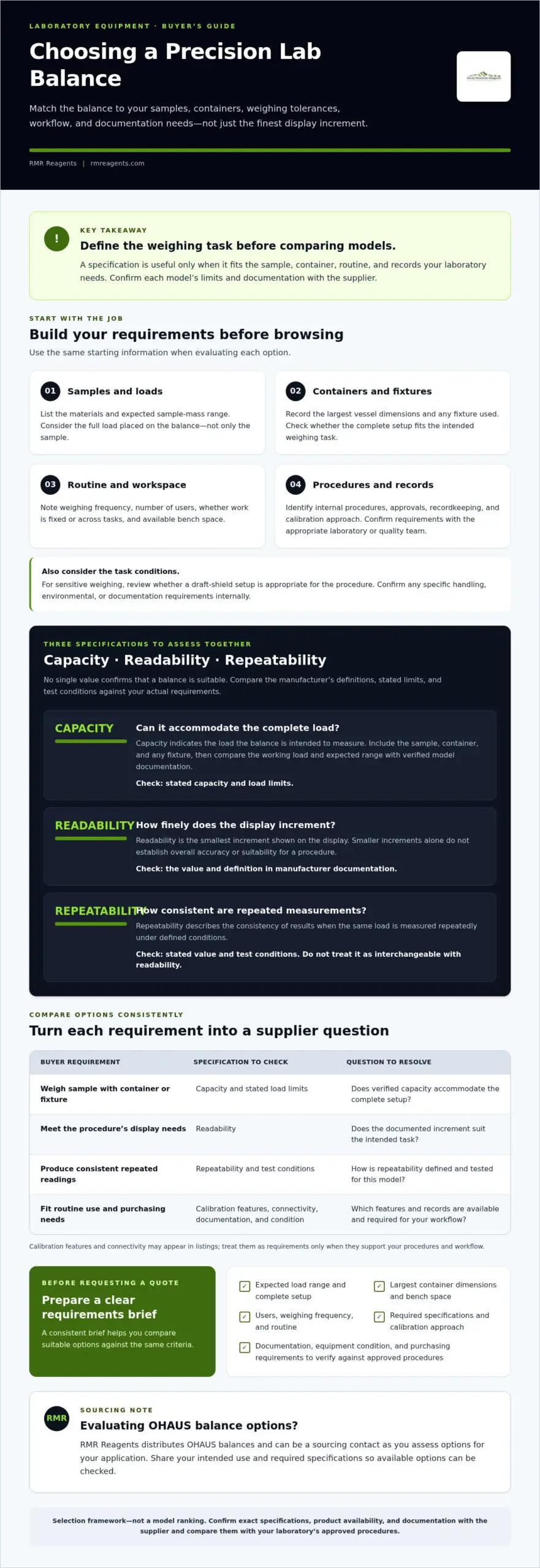
Start with the weighing task, not the product listing. Before comparing balances, identify what staff will weigh, the range of sample masses, the containers they use, and how measurements fit into routine procedures. A balance suited to small powder samples may not suit larger vessels or repeated production checks.
This guide is a selection framework, not a ranking of models or prices. Product availability and specifications need to be confirmed for each option. Define your operating requirements first, then assess supplier information against the same criteria. That makes it easier to compare options without relying on a product label alone.
Which weighing tasks will the balance perform?
List the materials, typical sample sizes, and vessels involved. Staff might weigh powders in small containers, liquids in larger vessels, or samples directly into process containers. Include container dimensions and how each vessel is handled during weighing so you can determine whether the complete setup fits the balance.
Distinguish occasional measurements from repeated or process-critical work. If a task has specific handling, environmental, or documentation requirements, confirm them with the relevant laboratory or quality team before choosing equipment. For highly sensitive weighing, review how an analytical balance is designed, including the role of its draft shield, and decide whether that setup suits your procedure.
What information should purchasing gather first?
Prepare a brief requirements record before contacting suppliers. Include the expected load range, largest container dimensions, available bench space, number of users, and weighing frequency. Note whether operators move between tasks or use the balance in a fixed workflow. These details help distinguish essential requirements from preferences.
Identify the procedures, records, and internal approvals that apply to the intended use. Don’t assume a particular standard or documentation package is required; check with the appropriate internal stakeholders. When reviewing supplier information, confirm that the manufacturer’s documentation can be compared with your approved laboratory procedures and purchasing requirements.
Key takeaway: Before requesting a quote, define the weighing task, sample and container range, bench constraints, user routine, and documentation needs. Share these requirements with each supplier so you can assess product fit against consistent criteria.
How do capacity, readability, and repeatability guide balance selection?
Evaluate these specifications together rather than treating any one as a complete measure of performance. Capacity indicates the load the balance is intended to measure. Readability is the smallest increment shown on its display. Repeatability describes how consistently it produces results when the same load is measured repeatedly under defined conditions. None of these values alone confirms that a balance meets your procedure’s requirements.
How should you match capacity to samples and containers?
Estimate the total load placed on the balance, including the sample, container, and any fixture used during weighing. Compare that working load and its expected range with the selected model’s verified manufacturer documentation. If the heaviest setup approaches a stated limit, ask the supplier about its suitability for your specific use rather than assuming the listed capacity guarantees a fit.
What do readability and repeatability tell you?
Readability describes how finely the display increments, not how close a result is to the sample’s true value. A display that changes in smaller increments does not, by itself, establish overall accuracy or suitability. Repeatability addresses a different question: whether repeated measurements of the same load remain consistent under the manufacturer’s specified conditions. Check each model’s definitions, values, and test conditions in its documentation. Don’t treat readability and repeatability as interchangeable specifications.
Use the same comparison method for each model you consider:
| Buyer requirement | Specification to check | Supplier question |
|---|---|---|
| Weigh the sample with its container or fixture | Capacity and stated load limits | Does the verified capacity accommodate the complete setup? |
| See suitable displayed increments for the procedure | Readability | What does the displayed increment indicate, and what does it not establish about performance? |
| Obtain consistent repeated results | Repeatability and its stated test conditions | Under what conditions was repeatability specified? |
For example, if operators weigh a sample in a vessel, first compare the combined load with the balance’s capacity. Then check whether its display increment and documented repeatability suit the procedure. Verify the specifications against manufacturer documentation before selecting a model.
If you’re assessing OHAUS balances through RMR Reagents, share your load, container, and performance requirements when you contact RMR Reagents. That information helps frame your inquiry around the specifications relevant to your workflow.
How can you compare precision balance options for your laboratory?
Compare verified models against the same requirements, not by feature count or sale label. Use your workflow requirements to identify essential specifications, then check each candidate’s manufacturer documentation and any documentation available for the specific unit. This gives purchasing and laboratory teams a consistent basis for review.
For broader equipment-selection context, consult High Precision Lab Equipment: A Practical Guide to Reliable Measurements. For balance comparisons, focus on whether documented specifications suit your intended tasks. A feature may be useful, but additional functions don’t automatically make a balance a better fit.
Which specifications belong in a side-by-side comparison?
Create one comparison record for each verified model. Include its stated capacity, readability, dimensions, operating conditions, and available documentation. Use consistent units across entries, and retain the manufacturer’s definitions so similar-looking terms aren’t mistaken for equivalent performance claims.
Group your requirements into two categories:
- Essential: Specifications and documentation required by your application or approved procedures.
- Helpful: Features that could support your routine but aren’t necessary for the balance to meet its core purpose.
If a listing omits a dimension, operating condition, or document detail, record it as a question for the supplier. Don’t fill gaps with assumptions or treat an unverified listing as a confirmed model specification. This is particularly useful when comparing precision lab balances for sale across product pages, where terminology or units may differ.
How should you assess product condition and support information?
Ask whether the specific unit being offered is new, used, refurbished, or clearance stock. The condition category alone doesn’t establish suitability. Request the relevant product documentation and confirm the warranty and support terms that apply to that unit before purchase. Don’t assume terms are standard across models, sellers, or conditions.
Keep confirmed details separate from open questions in your comparison. For example, record a dimension as verified only when it appears in manufacturer or supplier documentation. Flag missing condition or support information for follow-up, and confirm any service availability or coverage directly with the supplier rather than relying on a general product description.
A consistent comparison helps your team assess options based on application fit and documented facts, rather than an appealing feature list or an unverified condition claim.
What should you verify before ordering a precision laboratory balance?
Before placing an order, confirm that the exact unit and its documentation suit your application and laboratory purchasing requirements. Use this checklist to close information gaps before approval, particularly when comparing precision lab balances for sale from different suppliers.
Which product details should you confirm with the supplier?
Request the exact model identifier and current manufacturer specifications. Check them against the approved procedures for the intended use, and ask laboratory quality or metrology personnel to review any performance terms or requirements they oversee.
- Specifications: Verify the model identifier, capacity, readability, dimensions, operating conditions, and other requirements identified for the application.
- Documentation: Confirm which manufacturer documents are included or available and whether they provide the information needed for your internal review.
- Condition: Establish whether the specific unit is new, used, refurbished, or clearance stock. Request any condition details relevant to your evaluation.
- Accessories and support: Confirm which accessories are included and ask what warranty and support terms apply to that product. Don’t assume terms are the same across units.
- Purchasing requirements: Verify current availability and applicable purchasing terms directly with the supplier before submitting or approving an order.
How should your team prepare a purchase request?
Give the supplier a concise description of the application, expected load, required readability, container or fixture dimensions, and operating environment. Include the manufacturer specifications under review, the documentation your team needs, and any questions still awaiting confirmation. This lets the supplier respond to the specific request rather than make assumptions about your workflow.
Before approval, compare manufacturer documentation with your laboratory’s approved procedures. Record any internal approval, recordkeeping, or applicable procedure requirements, and route open technical questions to the responsible staff. RMR Reagents’ commitment to quality provides company-level context; it should not be interpreted as a balance-specific certification or claim.
Use the same information to prepare a clear product inquiry. Then confirm the model, availability, documents, condition, and terms with the supplier, keeping confirmed facts separate from details that remain pending.
Where can you inquire about OHAUS precision lab balances from RMR?
RMR Reagents distributes OHAUS balances. If you’re evaluating precision lab balances for sale, share your weighing requirements and ask RMR to confirm which OHAUS options are currently available, along with the exact specifications and purchasing terms for any unit you’re considering. This starts a product-fit discussion; it doesn’t guarantee that a particular model will meet your procedures.
What should you include in a balance inquiry?
Give the supplier enough information to assess your request without guessing about your laboratory’s needs. Include:
- Application: What staff will weigh, how often, and whether the work is routine or process-critical.
- Load and readability: Expected sample and container loads, plus the readability your procedure requires.
- Operating context: Container or fixture dimensions and relevant conditions in the balance’s intended location.
- Documentation and condition: Documents your team needs and any requirement for a new, used, refurbished, or other unit condition.
- Purchasing constraints: Internal approvals, recordkeeping needs, and purchasing terms your team must review.
Ask RMR to check current OHAUS options against these requirements. Request the exact model identifier, current manufacturer specifications, included documentation and accessories, and any applicable terms for the specific product. If a detail has not been confirmed, keep it open for follow-up rather than treating it as established.
How can RMR support the sourcing conversation?
RMR Reagents distributes laboratory equipment and lists OHAUS balances. OHAUS Corporation makes electronic and mechanical balances, scales, and laboratory and analytical instruments. Keep your inquiry focused on the intended use and product details that can be verified. Your laboratory team remains responsible for confirming that a candidate balance and its documentation meet approved procedures and internal requirements.
A concise request helps focus the discussion: “We need a balance for [application], with an expected load of [range], a readability requirement of [requirement], and [documentation or condition needs]. Please confirm current OHAUS options and provide the applicable model details and purchasing terms.”
Choose a Balance That Fits the Work
Selecting among precision lab balances for sale starts with the application, not the product label. Define the samples, containers, load range, and documentation your workflow requires, then compare verified specifications using consistent criteria.
Capacity, readability, and repeatability describe different aspects of balance performance. Review each term in the manufacturer’s documentation and compare the information with your laboratory’s approved procedures. Before ordering, confirm the exact model, condition, included documentation, current availability, and purchasing terms with the supplier.
RMR Reagents lists OHAUS balances among its laboratory equipment offerings. OHAUS makes high-precision electronic and mechanical balances. Share your application and requirements with RMR to discuss potential options, then confirm the model details and product fit for your specific inquiry.
A clear requirements list gives your team a sound basis for review and helps move the purchasing process forward with confidence.
Frequently Asked Questions
What is the difference between a precision balance and an analytical balance?
The distinction generally relates to the weighing range and sensitivity required, but terminology and specifications vary by manufacturer. Analytical balances are designed for highly sensitive measurements and commonly use a draft shield to reduce the effect of air movement. Precision balances often support a broader range of routine weighing tasks. Compare verified capacity, readability, and repeatability instead of relying on the product category name alone.
How do I choose the right readability for a laboratory balance?
Choose readability based on the smallest displayed increment your approved procedure requires, then assess other performance specifications separately. A finer display increment doesn’t guarantee a measurement is accurate or repeatable enough for your application. Review the manufacturer’s documentation and ask the appropriate laboratory personnel to confirm that the balance meets the method’s needs. Don’t select a model solely because its display shows more decimal places.
What capacity should a precision laboratory balance have?
Choose capacity based on the total load the balance will measure, including the sample, container, and any fixture used during weighing. Compare that working load and expected range with the exact model’s verified manufacturer specifications. If your setup approaches a stated limit, ask the supplier to clarify its suitability for your intended use. Maximum capacity alone doesn’t establish whether a balance suits your routine weighing task.
Does a laboratory balance need calibration?
What should I check before buying a used or clearance laboratory balance?
Confirm the unit’s exact model, condition, and current specifications, then request documentation for that specific balance. Ask which accessories are included and what warranty or support terms apply. Compare the manufacturer information with your laboratory’s procedures, including requirements for capacity, readability, and records. Before ordering, verify availability and purchasing terms with the supplier. A clearance label or lower price doesn’t confirm the balance’s suitability for your application.
Can RMR Reagents help me find an OHAUS balance?
Yes. RMR Reagents lists OHAUS balances among its laboratory equipment offerings and can be a sourcing contact for an inquiry. Share your weighing application, expected load, required readability, operating context, documentation needs, and purchasing constraints. Ask RMR to confirm current options, exact model specifications, availability, and applicable terms. RMR distributes OHAUS balances, and specific models and product details should be verified for your request.
Disclaimer
The information provided in this article is for general educational and informational purposes only and is not intended to replace product-specific technical documentation, Safety Data Sheets (SDS), professional advice, or applicable regulatory requirements. Chemical properties, applications, handling procedures, and regulatory requirements may vary by product, concentration, use, and jurisdiction. Always review the applicable SDS and product documentation and follow appropriate workplace safety procedures before handling or using any chemical product. Contact Rocky Mountain Reagents for product-specific specifications or technical information.

